Zero to One by Peter Thiel Review Chapter 11
Nada to 1: Summary and Review
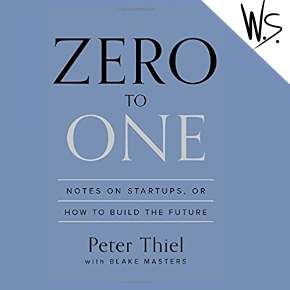
Keywords: Contest, Economics, Entrepreneurship, Future, Growth, Innovation, Monopoly, Startup, Teamwork, Technology
Delight Note: At that place are links to other reviews, summaries and resources at the end of this mail service.
Volume Review
Going from zero to one means going from nil to something. This is the greatest leap possible — greater than going from 1 to 10 or even from i to 100. To get from zero to one is to conjure something into existence from the dark void of oblivion. This is the essence of truthful innovation.
In Null to Ane, Peter Thiel draws on his experience at PayPal and Palantir to offering ideas and suggestions for engineering science startups. Unlocking the power of innovation is the primary goal. In order to reach this goal, the entrepreneur will need to question conventional wisdom, encompass monopoly and capture value for their new enterprise.
A graphic symbol as well known and controversial as Peter Thiel is at something of a disadvantage as an author. As much as some readers may admire him, others probably do non. The reader shouldn't allow whatsoever such luggage to keep them from readingZero to One. Taken on its own merits, the book is a well-written, idea-provoking read. The reader should maintain an open heed and evaluate Thiel's opus critically. Intellectual honesty is challenging, but it can bring the greatest rewards. This book is likely to challenge anyone'due south opinions, no matter where they may fall on the political spectrum. Groundbreaking ideas have a way of doing that.
One example of Thiel's unique reasoning is his enthusiastic embrace of monopoly. Thiel demonstrates not only his ability to come at an one-time topic from a new management, but too a fearless ability to speak heresy. Contest, he explains, is non the social skillful we were all taught that it was in econ 101. It results in anti-social behavior and squelches innovation. Monopoly, on the other hand, has the potential for positive effects. When a company knows it tin earn a termed monopoly via patents and like methods, the firm is motivated to invent new engineering science, which benefits guild. He is quick to state that monopolies tin can be misused past the greedy, but he doesn't linger on this betoken. No safeguards to protect society are considered or recommended. Theil seems to be too busy making his core argument to be sidetracked by such considerations.
Again, the flaws in this book shouldn't stop anyone from reading information technology, as long as they remain alarm to the problems. Consider it an opportunity to exercise critical thought. For the most part, this work offers solid communication for the entrepreneur and an intriguing peek into the mind of a truly unique thinker. It is sure to stimulate new ideas in entrepreneurs and non-entrepreneurs alike.
Summary
Chapter 1: The Challenge of the Time to come
The future is a fourth dimension when things will look differently than they do today. By this definition, the hereafter might not happen for another 100 years if zilch changes. On the other hand, the time to come might come up tomorrow if there is rapid modify. We don't know much about the future, but we practice know that it will be different from the present and that it will emerge from today'southward world.
There are two dissimilar kinds of progress. Horizontal progress occurs from copying things that work. Information technology's going from one ton, so that if you lot have a typewriter then you build 100 more, you lot've achieved horizontal progress. Vertical progress is achieved by doing something wholly new. It ways going from zero to one. This kind of progress is hard to imagine, because it's something that's never been washed before. If you take a typewriter and then you build a discussion processor, you've achieved vertical progress.
Globalization — taking things from i place and applying them everywhere else — is horizontal progress. Vertical progress comes from technological breakthroughs, and "technology," by the way, doesn't just describe computers. Any new manner of doing things can be called technology. Globalization and technology are two different kinds of progress that might or might not happen concurrently. You can accept one type without the other, you tin can accept both, or maybe neither of them. Between the two kinds, technology will exist the defining force of the future.
There'southward a tendency to imagine that we're nearing some sort of end land. Even the expression "adult world" implies that some countries accept climbed the mountain and that "undeveloped" countries just need to catch up. Our applied science isn't sustainable, however, especially if everyone else adopts it. We take limited resources and our environment tin can't endure the pollution that level of "development" would generate. Globalization without advances in technology would devastate the planet.
At i fourth dimension, people thought technology would continue to improve in all directions. Nosotros wouldn't have to work and so many hours, we'd exist riding in flying cars, nosotros'd be taking vacations to the moon. The only area that's seen real vertical progress, yet, is computer technology. Progress isn't a given; it doesn't happen automatically. Nosotros must first imagine and then create the world in which we want to live.
New technology comes from startups. Large organizations lumber effectually uselessly, and individuals don't have the resources to create an unabridged industry. Small-scale, agile groups foster innovation.
Chapter 2: Party Like Information technology'south 1999
It's piece of cake to fall casualty to popular delusional behavior. Conventional wisdom tin be persuasive.
One way to think clearly and eliminate delusion is to written report history. Look at the 1990s: some people accept warm, nostalgic sentiment for this era, merely both good things and bad things happened in the 1990s. Grunge music proves how bummed out everyone was.
Then, dotcom mania raged from 1998 to 2000. Investors were throwing money at any startup. People were leaving skillful paying jobs to strike out on their own and class new companies, certain that they would become rich. A lot of money was lost, simply people believed and so strongly in the dotcom economy that they didn't listen the warning signs. The cerebral noise of Silicon Valley was terrifying. The tech bubble and irrational exuberance made common sense seem like an eccentric attitude.
The dotcom crash brought the good times to a halt, and this trauma still affects Silicon Valley. Information technology instilled some deep-seated beliefs in the Valley that persist to this 24-hour interval, including suspicion of grandiose visions. Small-scale advances, incremental changes are safer. Agility became 1 of the about valuable characteristics a firm could have. Rather than investing in long-term plans, companies needed to be lean and hateful, able to respond to changing circumstances. Improving products in existing markets became more than important than creating new markets. Look at what competitors are doing and imitate them.
Many people consider these lessons learned to be of fundamental importance. Actually, at that place is probably more wisdom to be constitute in the contrary principles. There's a lot of value in being bold and making large moves. If it fifty-fifty needs to exist said, planning is important. Competitive markets aren't where the big profits tin can be institute; it'south better to create new markets. And information technology'southward important to keep in mind that sales are equally important as product. Advertisement is not a waste of resource.
People are overcompensating, but they need to get back to taking risks. They shouldn't become crazy with it similar they did in the 90s; they have to strike the right balance between caution and taking chances on innovation.
Affiliate iii: All Happy Companies Are Different
It's possible for a company to create a lot of value without really condign valuable itself. A successful company captures some of the value that information technology creates.
I important gene that determines how much a company earns is competition. The level of contest varies from company to company and industry to industry. Think of information technology like a calibration. On 1 terminate, you lot have a perfect monopoly where there is admittedly no competition. Some companies become monopolies past using questionable tactics against potential competitors; others become monopolies because they go licenses or lucrative contracts with the state. And so, there are some companies that achieve monopolies because they are innovative and take something unique to offer. When Thiel talks about monopolies, we're talking about this last group, companies that are so good that they have left their rivals in the dust.
On the other end of the scale, where there is a lot of competition, price is affected primarily past supply and need. The product that ane company offers is very similar to the product other companies sell. These companies take to cost the production at whichever point the marketplace forces determine. It isn't possible for companies to make much money under these circumstances.
Competitive businesses have super tight margins, while monopolies tin afford to call back about things besides the bottom line. (Monopolies are better for turn a profit.) Both monopolies and competitive companies are probable to tell white lies about themselves. Monopoly companies don't similar to invite authorities scrutiny by albeit that they are a monopoly; competitive companies tend to understate their competitive condition and emphasize ways in which they're unique.
In a static world, monopolies are bad because they just sit around and collect money. They can jack up the toll of their product, knowing that people volition have to pay whatever they charge. In a dynamic earth, however, monopolies are creative forces that give people more choices. And the government understands this. That's why nosotros accept the patent system that nosotros do. Patents allow companies to take monopolies for a while. Information technology incentivizes invention — companies know that if they invent something new, they'll take a monopoly on information technology for a substantial amount of time, so they'll exist able to make a good turn a profit from it.
Tolstoy observed that all happy families are alike, but unhappy families are each unique in their unhappiness. This is the reverse for business. Happy companies create unique monopolies for the circumstances they face. Unhappy businesses all take the same problem: competition.
Chapter 4: The Ideology of Contest
Innovative monopolies generate profits and create new products that benefit society. Competition limits innovation and profits. Nosotros accept been indoctrinated to believe that it's a positive force, merely competition is an ideology that doesn't serve united states of america very well. Our civilization reinforces this ideology, simply that doesn't make it any truer.
There are two different ways to wait at competition. You can frame it the way Marx did or the way that Shakespeare did. In Marx's world, people have conflict because their life circumstances have made them unlike from each other. Workers fight the bourgeoisie because they have alien goals and ideas. The way that Shakespeare saw it, however, is that people are mostly alike. They don't have many reasons to fight, but they do it anyway. The more they fight each other, however, the more they get similar one another.
When it comes to the globe of business, Shakespeare'due south viewpoint is more accurate. People get competitive with their rivals and lose sight of the of import goals. (Wait at Google and Microsoft like the warring families inRomeo and Juliet. They battle each other because they are similar.)
Competition limits vision and encourages obsessive hostility. It can mess with people's perceptions and priorities. It makes people copy one another, which limits their creative potential. It can cause people to see opportunities where none be. In the 1990s, there was intense contest among online pet stores: Pets.com, Petopia.com, Petstore.com and who knows how many others fighting for marketplace dominance. They were besides busy fighting amongst themselves to determine if online pet stores were fifty-fifty a lucrative enough concept to carp fighting over. Somewhen, the online pet store market place crashed and burned, taking enough of investment capital with information technology.
Sometimes the all-time manner to resolve contest is to merge with your rival. Thiel and Elon Musk were rivals until they both realized that the dotcom bubble presented a greater threat than either of them. So they merged. It was difficult to turn their rivalry into a partnership, but they overcame that challenge.
Sometimes y'all have to fight, and in those situations, y'all should fight hard and fight to win. Simply choice the right battles — information technology's non fighting over pride and laurels.
Chapter 5: Last Mover Reward
There are some startup companies that don't brand much money, yet they are valued higher than established companies with good cash flows. This seems illogical on its face, but there are actually good reasons driving this reality.
An important role of the value of a company is how much potential it has for profit in the future. Established firms in established markets have competition; their margins are chipped away past market forces. Startups in innovative markets are more likely to have monopolies; their good days are nevertheless alee of them. So fifty-fifty if the startup is losing coin information technology may well be more valuable than the established company that turned a turn a profit concluding year. Growth is fine, merely for information technology to be any skillful, you have to endure. A visitor has to survive in gild to succeed.
There are some characteristics that are typical features of monopolies. Every company is different, simply spotting these elements should help you to identify monopolies when you see them. Proprietary technology, for case, tin give a company a major advantage. Companies with applied science that offers something much meliorate than the nearest competitor are well positioned to go monopolies. If the technology is only moderately meliorate, withal, and then it will exist seen every bit a marginal improvement. In a crowded market, it won't impress anyone.
Network effects make a product improve. For example, the more friends you have on Facebook, the more than valuable Facebook becomes to you. Network businesses usually need to start small and scale upwardly, because it's hard to get millions of people to join at once. Many firms miss opportunities to get in on these types of businesses when they start up, considering they are so modest that they don't look very promising.
Companies get stronger when they become bigger. Economies of calibration ways that the price of running a business concern, like role space and engineering, doesn't increment proportionally when the company gets bigger. Monopolies calibration up well. Labor intensive industries, for instance those that depend heavily on customer service, don't scale well.
A strong make image can likewise strengthen a monopoly. Of form, there has to be substance behind the brand. One reason Apple has stiff make appeal is the high quality of its products. If a brand is little more than than a absurd name, it'due south possible for its product to become a temporary fad, simply it won't have staying power.
The lesson is to starting time pocket-sized and monopolize. In one case you lot have found your niche, scale up. Just don't intentionally set out to be disruptive. David taking on Goliath is a big bleed of energy and beside the indicate. The whole idea of disruptive technology is totally overvalued. First-mover reward is another. Sometimes information technology'southward meliorate to have the concluding significant boom and ride it longer. Call back of business as a game of chess — your strategy is important; you have to consider the endgame in social club to succeed.
Chapter 6: You Are Not a Lottery Ticket
Some people say that success is the event of luck. Others attribute success to hard work. But if success really were only a matter of luck, at that place wouldn't be those who accept been successful in a series of enterprises. The argument may never be completely resolved; information technology's not possible to run the kind of experiments that would be necessary to empirically prove whether success is the effect of luck or hard work. Historically, however, most great thinkers say that success comes from hard piece of work.
People today pay besides much attending to process and non enough to substance. People follow the rules for success, because they lack the inspiration to work toward a noun goal.
You tin can be an optimist or you lot can be a pessimist. You tin have a physical image of the future or i that'south fuzzy. And and so, you lot can have these things in different combinations — for example, y'all tin be a definite optimist or an indefinite pessimist.
Indefinite pessimists believe the time to come will be dark, but they don't have any ideas of how to change that. Decline is inevitable, so y'all might as well enjoy yourself in the concurrently. Indefinite pessimists are certain the future will exist bad, and then people should ready.
Nigh of the western earth was in a state of definite optimism from the 17th century until the 1960s or so. Scientists, engineers and businessmen knew they were making the earth a better place. Things were great and constantly improving. Men dreamed large dreams and congenital big projects. The party ended in the 1970s, when indefinite optimism gear up in.
In our current era, people remember the globe volition become meliorate, just they don't know exactly how that will happen. So they don't brand any plans. Indefinite optimism includes the world of finance, because nobody knows what the market will do, simply nevertheless, people keep investing in it. Politics and government have become indefinite, as well, through myopic focus on the curt term.
Philosophers are mapped out on a definite/indefinite optimistic/pessimistic chart. Postmodern philosophers Nozick and Rawls share the indefinite optimistic quadrant. Although they may exist different from each other, they're products of this indefinite optimistic era that we live in. Another thing that'due south indefinite? Biotech startups.
The problem is that indefinite optimism isn't sustainable. The futurity can't go better if no one plans for it. Nosotros demand to become back to a definite future. Nosotros accept little ability over philosophers or political pollsters, but we can render agency to our lives, according to Thiel, through the cosmos of startups.
Chapter 7: Follow the Money
There is a blueprint that's consistent beyond many different areas of human try: there are ordinarily a few players whose productivity eclipses those around them. It's chosen the 80–20 dominion, and so named past economist Vilfredo Pareto who noticed that 20% of the peapods in his garden produced eighty% of the peas. This tendency for the few to dominate the many is known equally the power law. It describes the exponential increment of effect at scale.
The power police is the courage of venture capitalism. Venture capitalists aim to detect, fund and turn a profit from early stage companies. These are high-risk investments, and many of the companies volition fail. But high chance can bring high rewards. Eventually some of the enterprises will succeed splendidly. They volition become office of the dominant 20% that win 80% of the earnings. This will cover the costs of the less successful investments and bring in a healthy profit, or so it's hoped.
It takes time for venture funds to selection a winner, and information technology takes more time for that winner to emerge from the balance of the pack. There are commonly lots of early failures, which means that venture funds commonly lose money at beginning. Venture capitalists just try to hang in there for the first few years, waiting for the kind of successes that volition launch them into exponential growth.
Just as most startups fail, nigh venture funds somewhen fail. Fund managers ordinarily aim for a diverse range of companies in their portfolio. Focusing on diversification makes information technology entirely possible that the few successful companies volition be missed entirely. For this reason, venture companies should merely fund enterprises that have the potential to pay off the entire investment of the whole venture company. This is a restrictive rule, and it means that venture funds will past necessity ignore a lot of promising businesses. It also means that venture companies can't really afford to restrict themselves any farther, because they risk overlooking the enterprise that volition provide the large payoff. Venture companies need to find the businesses that tin go from aught to one. In one case they place these businesses, they should dorsum them with every resource at their disposal.
It tin can be hard to stick to the discipline of the power law. It but becomes axiomatic over time. Solar day-to-day experience teaches that some companies are more successful than others and that most companies produce within the range of average performance. It's easy to get lost in these weeds. Information technology's as well difficult to dump companies once you are emotionally invested in them.
In some respects, we are all investors, whether or not we're venture capitalists. We invest a nifty deal of resource in pursuing a career. People attempt to stay diverse and endeavor to avoid putting all their eggs in one basket. They hedge against doubt. Schools provide a generalized education. It is much better for people to focus relentlessly on something that will keep to be valuable in the future.
Before you offset a company, consider that information technology will probable fail. It'due south much ameliorate to hitch your star to a company that has rapid growth. You might own 100% of your very own startup, but there's a big danger that you'll end up owning 100% of null. It would be much better to own 0.01% of a visitor similar Google.
Chapter viii: Secrets
This chapter is about secrets. Merely not real secrets. Rather, secrets in the sense of discoveries.
Simply about everything used to be unknown. Things that seem obvious today were non ever so, they had to be discovered.
There'south a modernistic tendency to say there are no hard questions left. Applied science has answered them. There are impossible questions that can never be answered. In that location are questions that tin can be answered easily, just answering easy questions isn't very satisfying. Unabomber Ted Kaczynski was of this belief. He was a terrorist who sought to destroy existing institutions then that people could start over answering hard and satisfying questions.
Hipsters like facial pilus and vinyl phonograph records. Peradventure this is considering they don't think there are new things that are worth pursuing. There is a pencil drawing of Kaczynski wearing a hoodie next to a drawing of a swain wearing a hoody. The caption reads, Hipster or Unabomber? Attempts at humour notwithstanding, the reader may be left with the impression that Thiel has a poor grasp of youth civilisation.
Fundamentalists also recall this way. Religious fundamentalists think there are the easy questions that anybody knows and the mysteries that only God knows. Everything else is heresy. Environmentalism is also a faith, a fundamentalist ane. The fact that we must protect the universe is the but truth that they know. Other than that, everything else is in the hands of Mother Nature, who cannot be questioned.
People may call up that at that place are no mountains left to climb; there is nothing left to observe. But this is wrong. At that place are certainly secrets left. Injustice, for example, thrives in an environs of ignorance; justice is restored by the beacon of knowledge.
You'll never observe something if you lot don't look, you'll never succeed if you don't effort. If y'all believe it's incommunicable, y'all won't do information technology. You accept to do it or it won't be done.
We tin can do amazing things. There are still amazing discoveries to exist done. But we take to try.
In that location are two kinds of secrets; there are secrets of nature and in that location are secrets about people. To find out about secrets of nature, you can written report the physical earth. Secrets well-nigh people are usually harder to find considering they are either things that people don't know about themselves or else they are things that people are actively trying to hide from others.
If you lot larn a secret, be careful who you share it with. Information technology could exist unsafe to reveal your noesis. Every bit a rule of pollex, it's all-time not to share secrets with anyone except for those y'all need to tell.
Sometimes y'all can shorten your journey considerably past taking the hidden path.
Chapter ix: Foundations
The start of a thing, the foundations, are really of import. Decisions made early on can be difficult to change afterward. Early mistakes can testify fatal to startups. This is the time when the background is laid, when the rules are written. The outset determines everything that comes after.
Exist very careful who your co-founder is. Don't do information technology with merely anyone. It'southward like getting married. Avoid an ugly divorce past existence careful who you choose for a partner.
Starting with the correct team is also important. Everyone on your squad has to get along. There needs to be structure. Roles should be well-defined. Don't worry about any of this stifling creativity. Creativity won't thrive in a state of anarchy; having some amount of arrangement is critical.
Ownership, possession and command are all different things. With startups, the owner usually has ownership and possession, while control ofttimes goes to the board. This tin cause disharmonize.
Pocket-size boards are better than big boards. It will be easier for them to reach decisions and manage conflict. Three lath members are good. Don't e'er have more than v board members. Even small-scale boards can bring bug for the house, nonetheless. A small board tin can be quite effective in opposing direction; for this reason, exist very cautious about the people you choose to serve on the lath of directors.
Avoid outsourcing. Keep everyone together, working total time for the team. Avoid telecommuting and role time workers. Everybody needs to feel like they are all pulling towards the same goal. It's like Ken Kesey said, "Y'all're either on the motorbus or off the passenger vehicle."
Go on the CEO lean and hungry. Low CEO pay keeps the CEO from getting stuck on defending the status quo. It also telegraphs to everyone else on the team how committed the dominate is. Low CEO bacon volition make information technology easier to keep everyone else's pay low besides.
People need to be adequately compensated. Cash bounty tends to keep people focused on short term value. For this reason, stock options are preferable to bonuses. Equity gives employees a part of the visitor and make them feel they really have a stake in information technology. But be careful to avoid letting people know the verbal corporeality of equity their coworkers hold; it could trigger jealousy and hostility. Employee stock options are a good style to increment loyalty, merely not everyone will similar it equally, though. Some people have a strong preference for cash pay.
Birth doesn't have to be a temporary miracle. As Bob Dylan said, those who aren't decorated being born are busy dying. Beginnings are periods of flexibility and are characterized by openness. This openness tin can exist institutionalized, instilling the company with a culture that encourages innovation. Your company tin can remain new and innovative indefinitely.
Chapter 10: The Mechanics of Mafia
Build a squad. Don't outsource cadre functions. Continue your group tight.
When you think nigh ideal visitor culture, maybe you lot imagine a place where not only do people dearest their work, but the place is also a fun place to be. Silicon Valley has been known for the firms that take ping pong tables and sushi chefs in the workplace. Merely these fancy perks do not brand civilization. In essence, the company is the civilization.
Thiel congenital a team at PayPal that included many people who went on to start all sorts of successful companies. Afterward they left PayPal, they founded well known startups including Tesla Motors, LinkedIn and YouTube. This cohort became known as "The PayPal Mafia." Thiel didn't follow the standard playbook of looking at resumes when he built his team. He wanted to put together a group of people who genuinely liked each other. He felt a fresh approach to hiring was needed.
To hire a good team, await at it from the prospect'due south point of view. Think nigh why they should want to work for yous. They probably hear from recruiters at other companies that they will make a lot of coin, that they'll work with smart people and that they'll help solve of import problems. All of these are nice things, but they are the things that potential employees hear from anybody. Y'all aren't giving them a reason to pick your company over a different ane when you use these reasons.
When prospects ask you why they should desire to work for you, the answer should exist specific to your company. To draw talented employees tell them why your visitor is unique and important. Don't try to sway anyone on the benefits of perks. You desire loyal employees, not people who actually care nigh free parking. Give your employees a standard benefits package that'southward typical in your industry.
To commencement, everyone should be as similar as possible. They need to piece of work well together. They should all be different in the same way; if they all dearest comic books or something like that it volition help them to become forth and to piece of work together.
Roles should exist well-defined. This reduces conflict. People won't be equally inclined to compete over turf. Internal conflict can exist deadly to a startup.
You lot want really dedicated people, but yous don't want to kickoff a cult. Not also much, anyway. People in cults are usually misinformed fanatics. You want a sure level of fanaticism in your group, but not misinformation. Y'all want a sense of specialness and separation from the outside world. You shouldn't mind too much if people say that your grouping is a mafia.
Chapter 11: If You Build It, Will They Come?
Sales are important. Middlemen have a bad name, merely they are crucial. Distribution is crucial. Many people, peculiarly tech people, don't understand the importance of this. But it'southward important.
Marketing is important because it helps people detect products. Advertising is useful because information technology works. It puts ideas in the consumer'southward mind. Yous might call back that you personally have some immunity to advertising that other people lack, but yous would exist wrong.
People are suspicious of sales staff because it isn't always so piece of cake to tell how hard they are working. All that schmoozing looks an awful lot like socializing. However, a good salesperson is like a expert histrion, they perform then well that it's difficult to see how hard they piece of work.
Splendid sales and distribution can create a monopoly even if the product itself isn't much different from its competitors. You demand to accept a stiff distribution plan in social club to succeed.
Distribution is measured with 2 numbers. The Client Lifetime Value (CLV) is the boilerplate amount of profit you lot tin expect to gain from a customer. This effigy has to be greater than the amount you spend to go that new customer; a figure known every bit the Customer Acquisition Toll (CAC). The more than expensive your product is, the more you should be willing to spend to go new customers. You should also be willing to devote more fourth dimension on each of them.
On one end of the calibration there are personal scales, where sales people deal direct with customers to sell expensive products. Really big deals are performed by CEOs more than salespeople.
At that place'southward a dead zone betwixt the expensive products that call for personal sales strategies and inexpensive products that can do fine with traditional advertising. A product selling for, say, $i,000 isn't really worth the expense of paying sales staff. The platonic client for the production is probably the small business possessor; mass marketing is a very inefficient way to reach this market place.
Marketing and advertising are for low-priced products, where there'due south not enough payoff for salespeople to sell them. Advertisement might exist appropriate for startups where the numbers aren't there for other distribution channels. But don't try to compete with large companies through advertizement campaigns.
Viral marketing lies at the far end of the calibration with the nearly cheap products. It's viral if information technology makes users draw in other users. For case, if someone sends money via PayPal, the recipient is exposed to the service automatically when they receive their money.
You accept to get at least one distribution aqueduct to piece of work or else you'll neglect.
Non only do you have to sell to customers, you besides have to sell your thought to investors and employees. And the media. Don't expect that your product is so wonderful that investors and everyone else will beat a path to your door. Develop a public relations strategy. Make up one's mind how you lot desire to tell your story.
Chapter 12: Human and Machine
Information technology has become and so dominant that it has become synonymous with the very word "engineering science." Computers continue to grow in power. Many functions in one case performed past humans have been taken over by computers. Some predict that this procedure will accelerate and computers volition continue have over more and more than man functions.
People worry virtually computers replacing people, that a process mirroring that of globalization is taking place. Just as jobs were lost to workers in other countries, they will now exist lost to computers.
People need not worry that this will happen, however. While people in one office of the globe aren't so different from people in some other role of the world, computers are very different from people. They practise non require the same provisions. Their capabilities are different. The kinds of things that people are expert at aren't the same as the things that computers are good at. People are able to make complex decisions. Computers are good at processing large amounts of data.
Computers are tools. The large technological advances of the future will happen in computers complementing — not replacing — people. We shouldn't exist afraid that computers will replace us.
People and computers combined can practise tasks better than either one tin can past themselves. This presents business opportunities. At PayPal, they developed a system for detecting credit menu fraud that involved algorithms that flagged suspicious transactions which would then exist reviewed by human operators. This demonstrates how the abilities of computers and people tin complement one some other.
With his startup visitor Palantir, Thiel developed similar software for the FBI to clarify information from multiple sources. Computers alone can't do that sort of work, nor tin humans do information technology alone. Computers and humans combined are capable of much more. There are all sorts of examples of how Palantir helped the feds bust terrorists, child pornographers and all manner of fraudsters.
At that place are many ways that computers can be harnessed to crunch the data and allow people to focus on complex problem solving. There are many opportunities withal to be developed that take reward of this synchronicity.
Software engineers have been taught to think up ways that computers can do people'southward jobs. But computers tin can't larn everything. It isn't just a matter of feeding them enough information. You can give computers more than and more data, simply this doesn't actually make them any smarter. They tin can't come up close to human analysis. Artificial Intelligence is certainly interesting, and it becomes more and more developed every day, but information technology still isn't shut to beingness able to take on complex assay. If the day e'er comes when information technology will be able to practise and then, that 24-hour interval is far in the future.
Chapter 13: Seeing Green
It seemed obvious that make clean technology was going to exist huge. At the beginning of the 20th century, lots of money was poured into new "cleantech" firms. Unfortunately, virtually of these firms ended up going out of business. They failed considering they ignored the bones elements necessary for success.
To ensure success, a startup needs proprietary technology that'southward significantly amend than the competition. The failed cleantech companies really dropped the ball on this one. Many of them were nigh twice as good as the competition, some of them didn't even hit this mark. In reality, a new product should be at least 10 times meliorate than the closest alternative. Your production has to be clearly, plainly better than anything else in guild to capture customer involvement.
Good timing makes all the difference. Some of those cleantech companies expected solar engineering science to accept off as fast as computer technology. Solar technology has been around for a long fourth dimension, yet, and its development has never been very fast. The growth of computer applied science has always been fast. You take to understand whether you are dealing with a slow or fast growing technology and treat it appropriately.
There isn't much money to be made in a competitive market. Startups emphasize their uniqueness for this reason. Nonetheless, it's better to be as realistic as possible to understand whether your product has a adventure at a true monopoly. In society to do this, you have to know what market you are actually in. If y'all brand solar panels and yous capture eleven% of the solar console market place, y'all might think yous're doing well. Information technology's possible, though, that the relevant marketplace that you lot should pay attention to is the global solar market, or even the unabridged renewables market. If you don't expect to the relevant market, you won't have the information that you need to evaluate your company'southward position.
The people leading a startup should be experts in the production, like engineers. You demand the right team for the job. The executives probably shouldn't be salesmen.
Distribution is as important equally the product. Find the right channel and communicate with the customer.
Cultivate immovability. Plan to exist the last mover in the market. Effigy out your plan for the next 20 years or so. Anticipate changes in the market.
You need to accept secrets. Great companies take reasons for success that others don't encounter.
Doing something skilful for society is a misguided goal. It'south better to do somethingdifferent. You will benefit guild more that way.
One of the few cleantech companies that has found success is Tesla. This is because they got all of the basic bug right. This shows that the problem was never with the thought of cleantech by itself, rather the problem was how most of the cleantech startups ran their firms.
Chapter 14: The Founder'south Paradox
The people who founded PayPal were unusual, from Thiel's perspective. His testify for this is that many of them came from exterior of the U.s.. An accompanying analogy shows six young men. The most striking thing almost the moving picture is how alike they all announced. They are all almost the same age, near of them wait to be approximately the same height and build, and their pilus is cropped short in a like style. While Thiel is rightly proud of his team'southward accomplishments, it's achingly clear that he is either oblivious to the issue of multifariousness or he simply doesn't think it's of import enough to address.
A chart is offered with supposed negative traits on ane side and supposed positive traits on the other. A bong curve demonstrates that most people are average, in the center of these extremes. In that location are no references indicating that this chart came from anywhere likewise Thiel's encephalon. It'southward presented equally if it were empirical facts, only the acute reader will not have it equally such. The labeled traits are highly debatable. Positive traits include qualities like rich, athletic and famous; yet exclude anything that might exist socially positive such as giving, philanthropic or helpful. Negative traits include outsider and poor, correct next to bellicose and villain. This chart is mostly useful for the glimpse it gives united states of america into Thiel's mentality.
The betoken being made here is that founders aren't normal people. They tend to occupy extremes of bong curves, sometimes occupying both ends at one time — for case, by being cash poor but rich on paper.
Some other nautical chart with the aforementioned traits show a slightly less-distinct bong bend. This chart is labeled Fat-Tailed Distribution. The term Fat-Tailed isn't defined anywhere in the text. Perhaps all the cool kids who took statistics know this means the possibility of a chart having skewed results, just it volition send anybody else to the dictionary to parse. Exactly how this relates to the discussion isn't mentioned. Another chart using the same traits is at least explained. The Founder Distribution is an inverse bell curve showing that founders take more of both the designated positive and negative traits.
Unusual traits are self-reinforcing. The cycle goes that unusual people act differently and develop extreme traits, which they exaggerate. Other people meet this and exaggerate the extremeness of the person when they depict them, which causes people to act differently.
Look at Richard Branson. Equally someone who founded successful businesses at a young historic period, he was certainly infrequent, but he didn't prefer some of his more eccentric traits until later on he became successful. Several others in this style are discussed, including Sean Parker and Lady Gaga.
Many examples are given of unique people who were founders. Information technology tin can be marvelous to non only think exterior the box simply to alive outside of information technology besides, only that isn't without its issues. A tremendous problem with standing out is that y'all can go a scapegoat when something goes incorrect. Celebrities provide us with many examples of how the mighty tin crash and burn.
Businesses need founders, even if they're a little eccentric. They tin exist magnets for hostility, notwithstanding. Bill Gates is a prime number case of this.
The most important thing to bear in listen is that founders shouldn't accept the ability and the glory too seriously.
Conclusion
Predicting anything beyond the next 20 or 30 years is perilous. At this juncture, in that location are four possibilities for what our future may exist.
In the by, the globe cycled between good times and bad. This pattern might exist the inescapable norm, and the bike could go on indefinitely. The conventional wisdom, though, is that through modern improvements, the world is reaching a plateau where things won't suck as bad anymore; the cycle volition be cleaved. However, you don't have to be a huge pessimist to see the possibility that we, as a species, are marching ourselves toward extinction. We'll have wars and problems, and poof, that's information technology for us. The optimistic have is that we're going to take off into a vastly improved future. Hopefully, it'll be this final option. Hopefully, we'll become from zero to one.
barrettnetrat1951.blogspot.com
Source: https://howdo.com/book-summaries/zero-to-one-summary-and-review/
0 Response to "Zero to One by Peter Thiel Review Chapter 11"
Publicar un comentario